일부 갑상선 기능 저하증 환자는 T4 공급으로 TSH를 정상화시킨 후에도 증상이 남아 있습니다.
기존에 안정적인 용량의 T4로 치료 중이던 75명의 갑상선 환자에서 T4 단독, T4와 T3 병합, 건조갑상선 추출물을 평가한 교차시험을 진행하였으며 환자 선호도 또는 갑상선 증상 또는 일반 건강 설문 점수에서 차이가 없었습니다. 하지만 처음에 가장 많은 증상이 있었던 20명의 환자는 T4 단독 치료보다 T4와 T3 병합 치료 또는 갑상선 추출물에 대한 강한 선호도를 보였고 점수에서도 유의미한 개선을 보였습니다. 이 하위 그룹 분석은 갑상선 기능 저하증의 원인, T4를 복용하는 동안 혈청 갑상선 검사, deiodinase 2gene의 다형성 유무에서 유의한 차이는 나타나지 않았습니다. 비록 T4와 T3의 일상적 병합 사용을 제안하지는 않았지만 선택적 환자에게서 T4와 T3 병합 치료 시도로 이득이 있을 수 있습니다.
Abstract
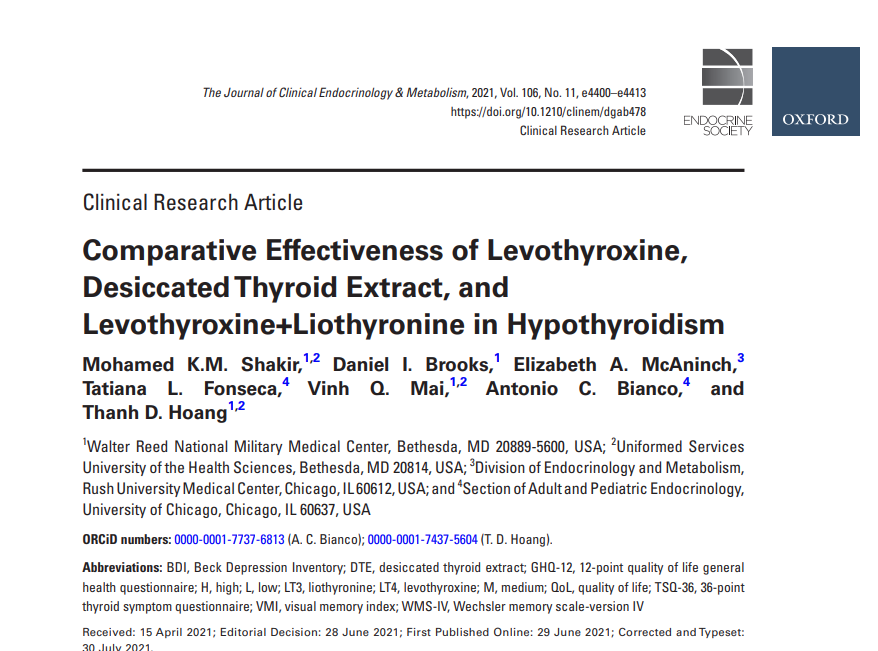
Introduction : Studies comparing levothyroxine (LT4) therapy with LT4+liothyronine (LT3) or desiccated thyroid extract (DTE) did not detect consistent superiority of either treatment. Here, we investigated thyroid paties, focusing on the whole group of LT4-treated hyroid patment
Methodology:Prospective, randomized, double-blind, crossover study of 75 hypothyroid patients randomly allocated to 1 of 3 treatment arms, LT4, LT4 + LT3, and DTE, for 22 weeks. The primary outcomes were posttreatment scores on the 36-point thyroid symptom questionnaire (TSQ-36), 12-point quality of life general health questionnaire (GHQ-12), the Wechsler memory scale-version IV (VMS-IV), and the Beck Depression Inventory(BDI). Secondary endpoints included treatment preference, biochemical and metabolicy parameters, etiology of hypothyroidism, and Thr92 Ala-DIO 2gene polymorphism. Analyses wereperformed with a linear mixed model using subject as a random factor and group as a factor and effect.
Results:Serum TSH remained within reference range across all treatment arms. There were no differences for primary and secondary outcomes, except for a minor increase in heart rate caused by DTE. Treatment preference was not different and there were no interferences of the etiology of hypothyroidism or Thr92Ala-DIO2 gene polymorphism in the outcomes. Subgroup analyses of the 1/3 most symptomatic patients on LT4 revealed strong preference for treatment containing T3, whichimproved performance on TSQ-36, GHQ-12, BDI, and visual memory index(VMS-IV component).
Conclusions: Asagroup, outcomes were similar among Hypothyroid patients taking DTEvs LT4+T3vs LT4. However, those patients that were most symptomatic on LT4 preferred and responded positively to therapy with LT4+LT3DTE.